




Team coaching

As with any relatively new discipline, coaching is continuing to evolve. I welcome the shift from the singular focus on the individual to a broader focus on what happens within, between and beyond teams. I feel deeply privileged to be a voice in this transition, as coaching works out to have a wider societal impact.

Team Coaching
Team Coaching

The challenge for teams?

In previous centuries, work was designed around the individual. However, in today’s global, ever-changing and complex world, the collective power of teams is the currency in modern organisations. Despite this, all is not well in the world of teams. A study of 120 senior leadership teams revealed that only 21 per cent were described as outstanding (Wageman et al, 2008), while another study found only 13 per cent of teams operating at the highest level (Price and Toye, 2017).

Today, there is a growing recognition that team building, facilitation and training, to name a few, are no longer enough their own. Something more profound and more sustainable is required. In serving this need, team coaching has become the fastest growing area in the global coaching industry.

Team Coaching

What is team coaching?

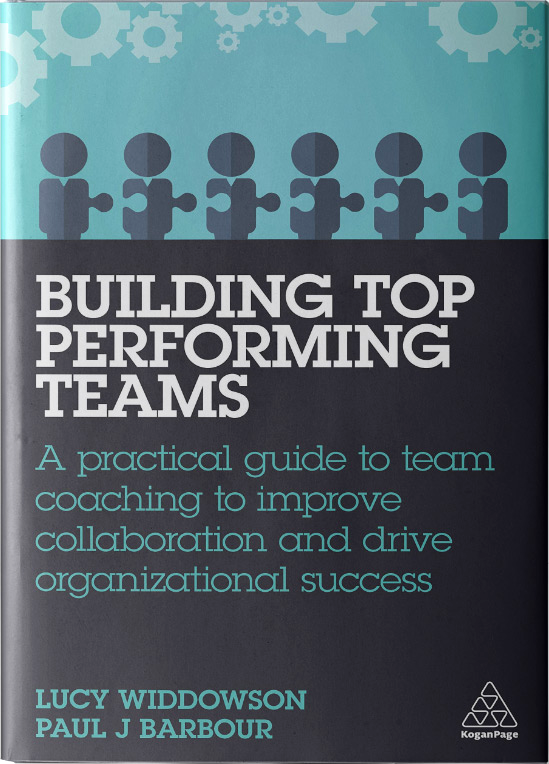
Despite being the fastest-growing area of coaching practice, there is still much confusion as to what team coaching is and is not. When writing Building Top Performing Teams, my co-author Lucy and I spent significant time reviewing the literature and reflecting on our experience to develop a definition that we believe is easy to understand.

‘Team coaching helps teams work together, with others and within their wider environment, to create lasting change by developing safe and trusting relationships, better ways of working and new thinking, so that they maximise their collective potential, purpose and performance goals’.

(Widdowson and Barbour, 2019)

The definition has seven key elements:

1.

Team

Many teams are teams in name only. Before considering if team coaching is right for you, it is essential to ask: Are we a real team? A team is ‘a small number of people with complementary skills who are committed to a common purpose, performance goals, and approach for which they hold themselves mutually accountable (Katzenback and Smith (1993)’.

2.

Coaching

Coaching activities and a coaching philosophy should be at the heart of any team coaching intervention.

3.

Helps teams work together, with others and within their wider environment

Every team is part of a much broader system, which, if not acknowledged and given the focus it requires, has the power to sabotage even the best of teams. For this reason, team coaching should never just be about the team itself. The idea of a Team of Teams, was popualrised in the book by the same name (McChrystal et al, 2015). Team coaching supports teams to work effectively within and across organisations.

4.

To create lasting change

As in one to one coaching, team coaching is about partnering with clients on a journey. The team coach will always emphasise the team taking responsibility for their change journey.

5.

By developing safe and trusting relationships

Team coaching supports teams develop psychological safety, where team members feel safe to be themselves, take risks and learn, especially when things don’t go to plan. The team coach will support the team develop a culture where support comes before the challenge and where there is enough trust for open and honest conversations to become the norm.

6.

Better ways of working

While not offering expertise in all every way the team can work, team coaching supports a team in developing awareness of what needs to change in how they work together. Typically areas a team may wish to focus on include: decision making, team meetings (in-person, virtual and hybrid), communication, and internal and external processes and the rhythm that underpins them.

7.

New thinking

The ICF talks about one-to-one coaching being a “thought-provoking and creative process” (ICF, 2020). In the same way, team coaching supports a team to shift their thinking from the immediate to what the future requires. Typically areas a team may wish to focus on include: how the team learn together, team creativity and innovation, team inclusion and diversity, and team well-being.

Adapted from Widdowson and Barbour (2021).

What role do team coaching frameworks, models and approaches play in your work?

I was privileged to co-author 85,000 words with Lucy Widdowson in Building Top Performing Teams, based around the Creating the Team Edge framework (see the book).

The framework includes a model of team effectiveness and an approach as illustrated below. While the model and approach have been proven through research to improve team effectiveness, Lucy and I, when writing our book, were at pains to point out that no model or approach is ever the work itself.

The essence of the work is how the team coach creates a safe space for teams to be courageous enough to do the work that the future requires of them. In our book, we talk about the preeminence of a team coaches’ way of being’, that is how they connect deeply with the team, have confidence in their own story, display courage in the moment and have the humility to always to be learning.

I believe that as long as a team coach is clear on what is essential, i.e. their ‘way of being’, frameworks, models and approaches are extremely useful.

Do you team coach alone?

I rarely team coach on my own. The sheer complexity and depth of the work is best served by having two team coaches. I’m deeply honoured to partner with some of the best team coaches I know. (see collaborations).

What could a team coaching journey look like?

In the same way that every team is unique, every team coaching journey is different. The following illustration highlights some of the critical elements you might find in a team coaching journey. Despite what this illustration might convey, it is essential to point out that team coaching is not a linear step by step process. Due to the complexity of the environment in which teams operate and the often invisible group dymanics, team coaching journeys can be complex, messy, and unpredictable. Nevertheless, as any team coach will share, there is few better feeling than witnessing teams make the shift from ordinary to extraordinary. Is your team up for the challenge?

My invitation to connect

To book your free 30-minute discovery call, please feel free to drop me a line.

"This is a compelling and important contribution to the team coaching literature that is extremely clear and easy to follow."

EMCC Master Practitioner, Executive Coach and Coaching Supervisor

Dr Alison Hodge

Executive Coaching

Executive coaching

There are few better feelings than witnessing a coachee make a positive shift in their consciousness and discover the truth about their own potential

Speaking

Speaking

It is my honour to share with others my passion for how humans can collaborate and perform at the highest level.

Publications

Publications

I desire to research and write words that evoke awareness and challenge the status quo on how human beings can collaborate better.

Collaborations

Collaborations

I collaborate on delivering global individual and team coaching assignments and other activities.


Contact me

If you want to say hello, discuss anything I have written about on this website, or explore how coaching with me and those I partner with, could benefit you, your team(s) or organisation, I would be delighted to hear from you.

In the last several years, here are some of the companies I have been honoured to work with