
Building Top Performing Teams
Widdowson L and Barbour P J (2021)
Building Top-Performing Teams: A Practical Guide to Team Coaching to Improve Collaboration and Drive Organizational Success.
Kogan Page Publishers.
Use AHR20 code to get 20% discount.
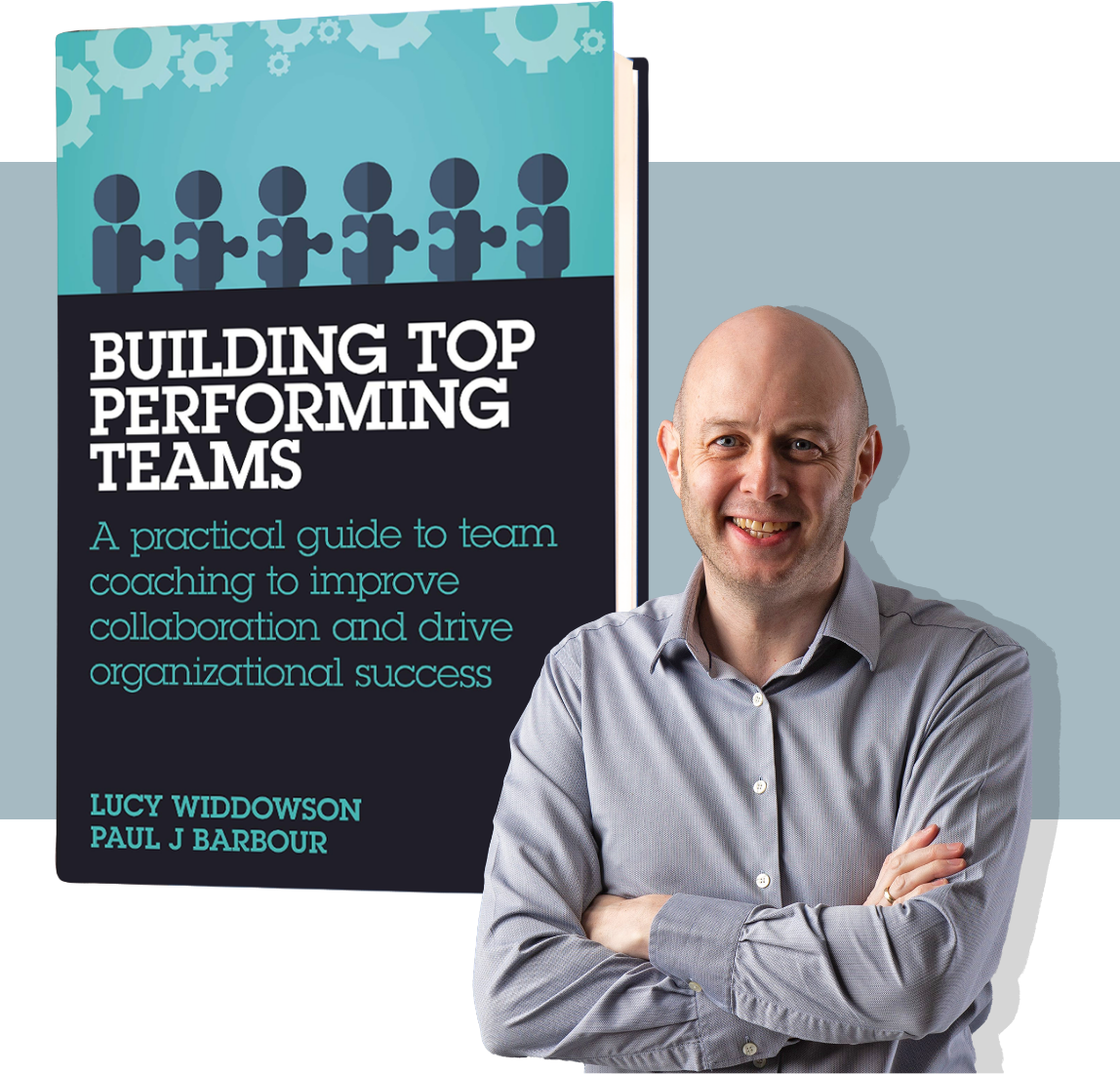
Where you can buy the book

On publisher's
website
Buy hard copy, ebook or audiobook. Use AHR20 code to get your 20% discount.

Globally
on Amazon
Buy it on the "one of the most influential economic and cultural forces in the world".

Support
local bookstores
Buy at the bookstore near you and support it (if you live in the UK or USA).
Do you need
more than 10?
If you would like to bulk purchase for your organisation, please contact Christina Lindeholm.
The story behind the book

I never give the conversation much thought after that. However, shortly after graduation in October 2018, an e-mail from Lucy resulted in several contracting conversations. Just over two years later (considering a COVID-19 publishing delay), on the 3rd January 2021, the book had gone from an idea to a reality. As outlined in our acknowledgements section, we have so many people who supported us, especially our families.
I can honestly say the writing the book was one of the hardest things I have ever done regarding the effort required. However, it has equally been a transformational journey that I am so glad we both persevered on. Not only do we now have a book that we are both incredibly proud of, but we also have a friendship that I hope will be lifelong.
Watch the story behind our book


Our purpose for writing the book
When writing the book, Lucy and I lived out each of the seven characteristics of the ‘Creating the Team Edge’ model created by Lucy and her colleagues in 2015. We became a core team of two, who collaborated with multiple other teams across several organisations. We were deeply conscious of the wider environment in which we were operating, both past, present, and future. It was important to both of us to have an agreed team purpose for writing the book. We agreed that our team purpose was ‘to help teams within and across organizations collaborate better, to create meaningful lasting change’. We hope and trust that our book will honour this purpose.
Who should consider reading it?
Based on the feedback received to date, Building Top Performing Teams is proving beneficial to several audiences, including:
Managers
Can benefit from learning about the core principles of how humans perform in teams.
Leaders
Will learn how to become a better team leader by using the principles and approaches that underpin team coaching.
HR professionals
Will assist HR professionals who work directly with and coach teams. It will also help HR professionals decide on how best to use team coaching in their organisation.

Organisational consultants
Anyone interested in the psychology of building top-performing teams will benefit from reading the book, including agile coaches.
Coaches
Coaches looking for an introduction to team coaching or coaches who are aspiring to become a team coach, will benefit.
Team coaches
While the book is benefiting each of the audiences mentioned, the book is particularly relevant to practising team coaches, both new, experienced and everything in between.
Whats in the book?
The book can be split into three sections.
Chapters 1-3
Chapter 1 – Introduction
We outline why the challenges of today and the future, require much more than brilliant individual leadership. We need teams and teams of teams, that operate in a purposeful manner within and between organisations. Team coaching, its benefits and how it differentiates from other forms of team intervention, is also explored.
Chapter 2 – Beyond tools and techniques
Discusses our views on what it takes to be a team coach. Among other models, we introduce the ‘Being, Doing and Knowing’ model of team coaching competency, as well as the 4 C’s of Being model.
Chapter 3 – Team coaching frameworks, models and approaches
Introduces readers to the ‘Creating the Team Edge’ framework that includes a model of team effectiveness and an approach that can be used by team coaches. The model and approach were developed by Lucy in 2015, with input from colleagues, while she was a partner in Performance Edge Partners Limited. Since 2015, Lucy continued to develop and research the ‘Creating the Team Edge’ framework, culminating in our work together in writing the book.
The seven characteristcs of team effectiveness are illustrated as follows:

CREATING THE TEAM EDGE
© Performance Edge 2015
‘Creating the Team Edge’ - Seven characteristics and descriptions
Characteristics
Purpose
Identity
Values and beliefs
Awareness
Relatedness
Ways of working
Transformation
(Widdowson & Barbour, 2019)
Chapters 4–10
These chapters discuss the seven characteristics of team effectiveness as outlined in the ‘Creating the Team Edge’ framework in the following order: team purpose (Chapter 4); team identity (Chapter 5); team values and beliefs (Chapter 6); team awareness (Chapter 7); team relatedness (Chapter 8); team ways of working (Chapter 9); and team transformation (Chapter 10).
For each characteristic, the following format is followed:
- definition of the characteristic;
- the psychology behind the characteristic;
- the importance of the characteristic in organizations;
- developing the characteristic in teams;
- the challenges of the characteristic in teams;
- tools and techniques for developing the characteristic in teams;
- reflective questions regarding the characteristic.
Importantly, for us the book not only looks at the evidence and theory relating to team coaching, but it is also highly practical. The 42 tools and techniques (six per chapter) presented in chapters 4–10, can each be used in person or virtually.
Chapter 11 – Conclusion
In our conclusion, we present our views about the future of team coaching.
What others have been saying about the book?
We were honoured that one of the world’s leading pioneers in the discipline of team coaching, Professor Peter Hawkins, agreed to write the foreword for our book. In the forward Peter commented,
“I welcome this important new edition to the growing literature on how to coach and develop teams and hope it will not only help many team coaches but also team leaders and team members in finding their own pathways to becoming highly-effective teams that create beneficial value for all their stakeholders”.
Professor Peter Hawkins – Renewal Associates.
We were also honoured and humbled that some of the worlds leading experts and influencers in team coaching, along with several industry leaders, kindly reviewed and endorsed the book. Some examples of what people have said include:
“Lucy and Paul have crafted a tour-de-force on team coaching. This comprehensive, well-researched book is jam-packed with nuggets yet flows like a novel, seamlessly from topic to topic”.
If you want a comprehensive companion of current thinking and practical applications to unlock the collective power of teams, this book is it..
As we move away from the heroic leader towards distributed leadership, operating in complex, dynamic systems, leaders need to be able to curate and craft team performance, like a conductor or a premiership coach. Building Top Performing Teams is written by two highly experienced practitioners, who bring their insights from practice, and blend this with the emerging science on team performance to create a book for our time. This is an ideal read for team coaches, consultants and leaders concerned with creating work relationships which deliver more than the sum of their parts.
Widdowson and Barbour have delivered a powerful and practical guide for team coaches to help them connect more deeply with their ‘way of being’ as a coach and with the teams they are coaching. This is an important book for team coaches supporting teams on their journey to transformational performance.
Grounded is a word that springs to mind when I think of the potency of this book. As a new and burgeoning practice, Team Coaching - what it is and how it works - still eludes many. This book clearly situates the discipline and rightly positions it amongst the many modalities that support team efficacy. The authors ground us in the literature over the first three chapters which in and of itself is no mean task but the effect on the reader is comfort. I know where I am. They then share their own proprietary model that underpins their work with teams in an incredibly accessible manner, littering the pages with ideas/examples/exercises all generously shared. This book is a re-read, over and over again. You will feel extraordinarily guided as you move through your own practice or work with teams, with this book as your companion.
Never before have teams been so important to our future as the problems of the world today will only be solved by greater collaboration and teamwork. This new work is a welcome contribution to the literature on teams. Whether you are a leader, team coach or facilitator, this is packed full of useful tools and techniques that will expand and enrich your team development toolkit.
If you’re looking for a comprehensive overview of team coaching that balances theory and practice, then look no further. Widdowson and Barbour have created a thorough overview of the doing and being of team coaching structured around important team topics. Whether you are an aspirant or experienced team coach, this book has something to offer you.
Lucy and Paul’s guide to team coaching is my blueprint for creating top team performance. It builds upon the critical team foundations of purpose, identity, values and beliefs. I have applied the knowledge and experience shared in this book across my organization, and it has delivered continuous improvement and outstanding results for our business, our customers, our many other stakeholders, and in the lives of the inspired and motivated members of my wonderful team.
This is a compelling and important contribution to the team coaching literature that is extremely clear and easy to follow. There is a genuine appreciation for value and importance of supervision as an integral element to support the team coach.
Any executive looking to transform their team in these ever-challenging times will get tremendous insight and practical guidance from this book. Its clear and accessible content, based on both academic principles and practical team coaching experience of the authors, will become required reading for all those looking to lead or coach teams in how to go to the next level of performance and effectiveness. Not only will a team benefit itself from engaging in the authors’ coaching model to create the ‘team edge’, but the effectiveness of other teams in the organization that interact with that team will also improve as a result.

Join us now on our journey
To help teams within and across organizations collaborate better, to create meaningful lasting change.

Where you can buy the book
On publisher's
website
Buy hard copy, ebook or audiobook. Use AHR20 code to get your 20% discount.
Globally
on Amazon
Buy it on the "one of the most influential economic and cultural forces in the world".
Support
local bookstores
Buy at the bookstore near you and support it (if you live in the UK or USA).
Do you need
more than 10?
If you would like to bulk purchase for your organisation, please contact Christina Lindeholm.